

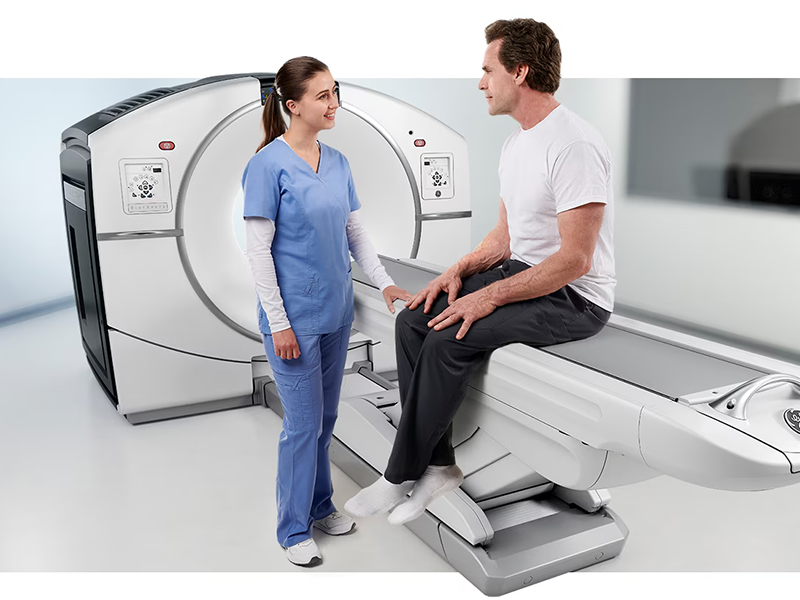
A Positron Emission Tomography (PET)–Computed Tomography (CT) examination combines two major imaging modalities to offer a unified view of the body’s internal structures. It is a highly sensitive imaging modality that helps detect early stages of disease often undetectable by CT alone, or by other imaging procedures such as MRI. Instead of relying solely on structural pictures, it presents detailed visual information at both cellular and metabolic levels. The technology produces precise, multi-dimensional coloured images that help clinicians observe subtle changes that may not be visible on standard imaging methods. Over the years, significant technological improvements have helped enhance clarity, shorten scan duration, and reduce radiation exposure for patients.
PET CT working methodology
When a disease is present, the biochemistry of cells and tissues changes. In cancer, for example, cells begin to grow at a much faster rate. A PET CT scan begins with an injection of a glucose-based radiopharmaceutical called fluorodeoxyglucose (FDG). The FDG travels through the body and eventually settles in any organs or tissues that have an increased metabolic activity, such as an area of rapidly growing cells.
During the scan, the patient lies on a table that moves through the PET CT scanner. The cameras in the PET scanner detect gamma rays emitted by the FDG in the patient. It converts these gamma rays into electrical signals and then into digital images. If there are any areas of increased metabolic activity, such as a cancer, the signals will be stronger, since more of the FDG will have been absorbed in these areas. The CT component of the scan adds anatomical information to the PET scan, and provides very accurate information on the location of disease in the body.
Beyond oncology, the scan also supports the evaluation of neurological and cardiac disorders, and has contributed to progress in understanding degenerative conditions such as Alzheimer’s disease.
When is a PET/CT scan used?
- Cancer: to show active areas for staging.
- Brain tumours: to see if a recurrent tumour is present.
- Heart problems: to show blood flow and metabolism
- Alzheimer’s disease: to show areas of reduced activity.
- Epilepsy: to show where the seizures are coming from.
- Parkinson’s disease: to show areas of reduced function.
Before booking an appointment, many individuals may compare centres by searching terms such as PET CT scan price, especially in regions like Delhi-NCR where multiple facilities offer advanced imaging services.
Preparations
Before the procedure:
- Allow up to four hours for your appointment. Do not arrange any other appointments before or after this one.
- You will need to fast for four hours prior to your appointment. Eat nothing and drink only water.
- You will need to be well hydrated. Drink four glasses of water in the 2 hours prior to your appointment and empty your bladder as needed.
- Bring a list of all your current medications with you to your appointment.
- If you are diabetic, please call us to discuss your medication as additional preparation may be needed.
- To achieve the best possible scan for your specific needs, it may be necessary to use oral contrast.
During the procedure:
- You will be asked to remove any jewellery and clothing items made of metal and you will be given a gown to wear.
- You will be asked to empty your bladder prior to the start of the procedure.
- An intravenous (IV) line will be inserted into your hand or arm for injection of the radionuclide, fluorodeoxyglucose (FDG).
- After the injection, you will then be asked to rest quietly for about an hour. This allows the FDG to concentrate in the organ or tissue of interest.
- After the FDG has been absorbed for the appropriate length of time, you will be taken into the PET CT scanner room. You will lie on your back on a table that will then moves through the scanner.
- When the scan has been completed, the IV line will be removed.
PET CT is a very safe and routine procedure and the duration of the scan may vary, depending on the organs being assessed and whether additional agents are needed. The results obtained through PET-CT help guide ongoing management and reduce the likelihood of unnecessary surgical procedures. In many long-term treatment plans, multiple scans may be scheduled at different stages to monitor progress.
After the images are captured, a radiologist or nuclear medicine specialist studies them carefully. A comprehensive report is then prepared for the referring clinician, who combines these findings with the patient’s symptoms, treatment history, and examination results to make informed decisions.
Disclaimer: For personalised advice and further information, always consult your doctor or qualified healthcare professional.
 Cares My Health Blog